 01↗
01↗AI as a QA Copilot: Where It Helps and Where Humans Must Decide
A practical look at using generative AI for test design, defect analysis and documentation—without blindly trusting automatically generated answers.
Read article →Insights from practice · 2026
Twenty current topics from Quality Assurance, testing, data, AI and process improvement—practical, clear and focused on real impact.
 01↗
01↗A practical look at using generative AI for test design, defect analysis and documentation—without blindly trusting automatically generated answers.
Read article → 02↗
02↗Non-deterministic outputs require a different verification strategy from a traditional function with one exact expected result.
Read article → 03↗
03↗Automation delivers the greatest value when it protects critical journeys and removes repeated manual work.
Read article → 04↗
04↗A small change in data structure can break an integrated process even when every team considers its own service healthy.
Read article → 05↗
05↗Incorrect results can originate during import, transformation, segmentation or export. Checking only the final report is not enough.
Read article → 06↗
06↗Realistic data matters for testing, but copying production information is not automatically the right solution.
Read article → 07↗
07↗Quality is not created only during a test phase. It starts when requirements are shaped and continues through observation in production.
Read article → 08↗
08↗Logs, metrics and traces are not only operational tools. They also show whether a system can explain its own failures clearly.
Read article → 09↗
09↗An accessible product is clearer, easier to operate and more robust for a much wider range of users.
Read article → 10↗
10↗A test that passes and fails without a product change gradually stops being taken seriously.
Read article → 11↗
11↗When everything cannot be tested, priority should reflect impact, likelihood and the chance of detecting failure in time.
Read article → 12↗
12↗A quick fix restores service. Understanding the cause reduces the chance that the problem returns.
Read article → 13↗
13↗The number of tests or defects alone does not show whether the product is safer or the team more effective.
Read article → 14↗
14↗An ambiguity discovered during refinement is cheaper than a defect discovered immediately before release.
Read article → 15↗
15↗Exploratory testing is not random clicking. A well-designed charter gives the investigation a purpose while preserving room for discovery.
Read article →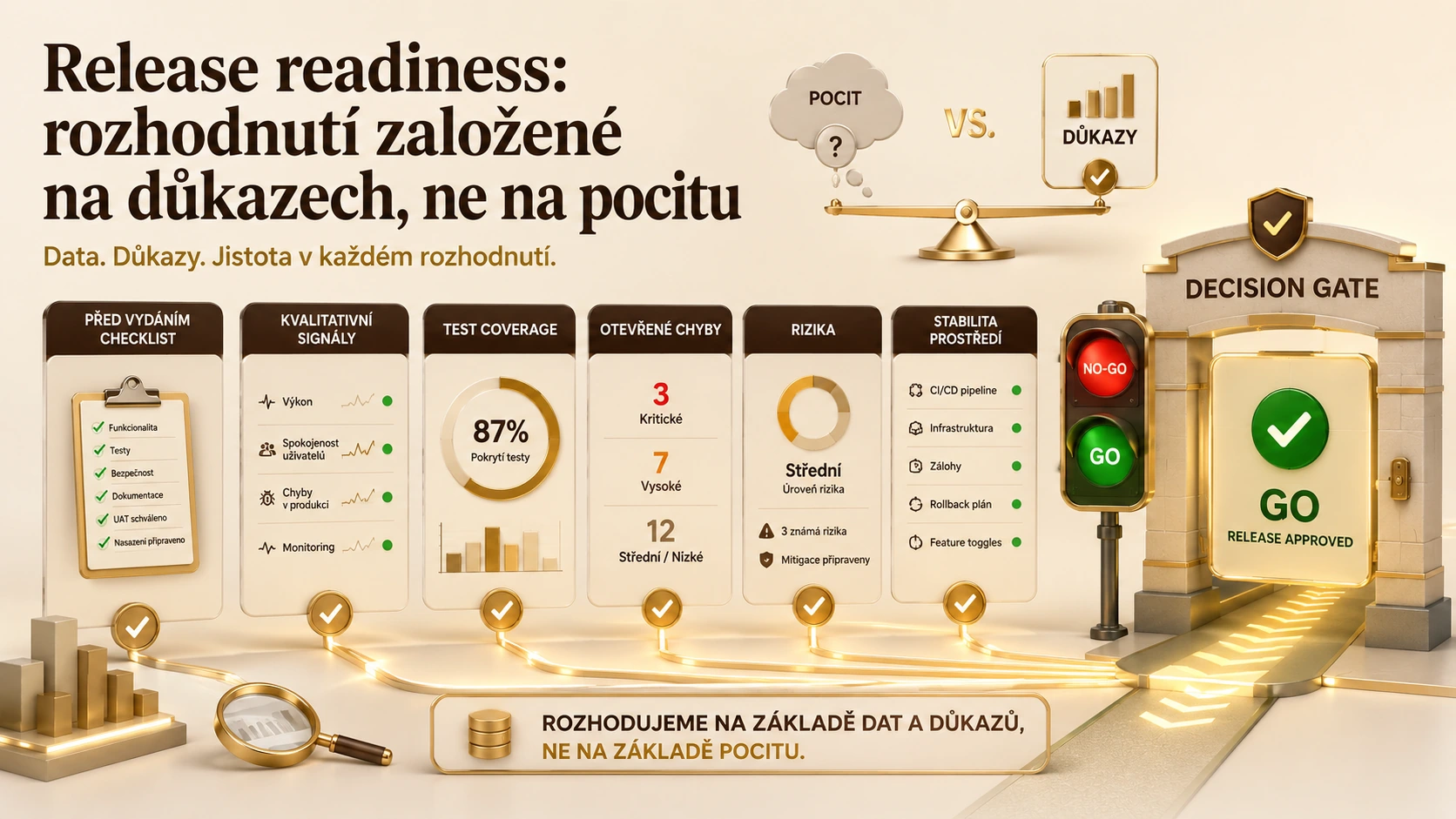 16↗
16↗Passing tests is not enough before deployment. The team needs a shared view of change, risk and operational preparedness.
Read article → 17↗
17↗It is impossible to manually verify every combination of device, browser, resolution and operating system.
Read article → 18↗
18↗Performance is not only the speed of one screen. It includes response time, throughput, stability and behaviour under peaks.
Read article → 19↗
19↗A strong defect report enables another person to understand, reproduce and assess the impact of the problem.
Read article → 20↗
20↗Improvement is not a long list of ideas. It is choosing one concrete change, testing it and returning to the result.
Read article →