Why this matters
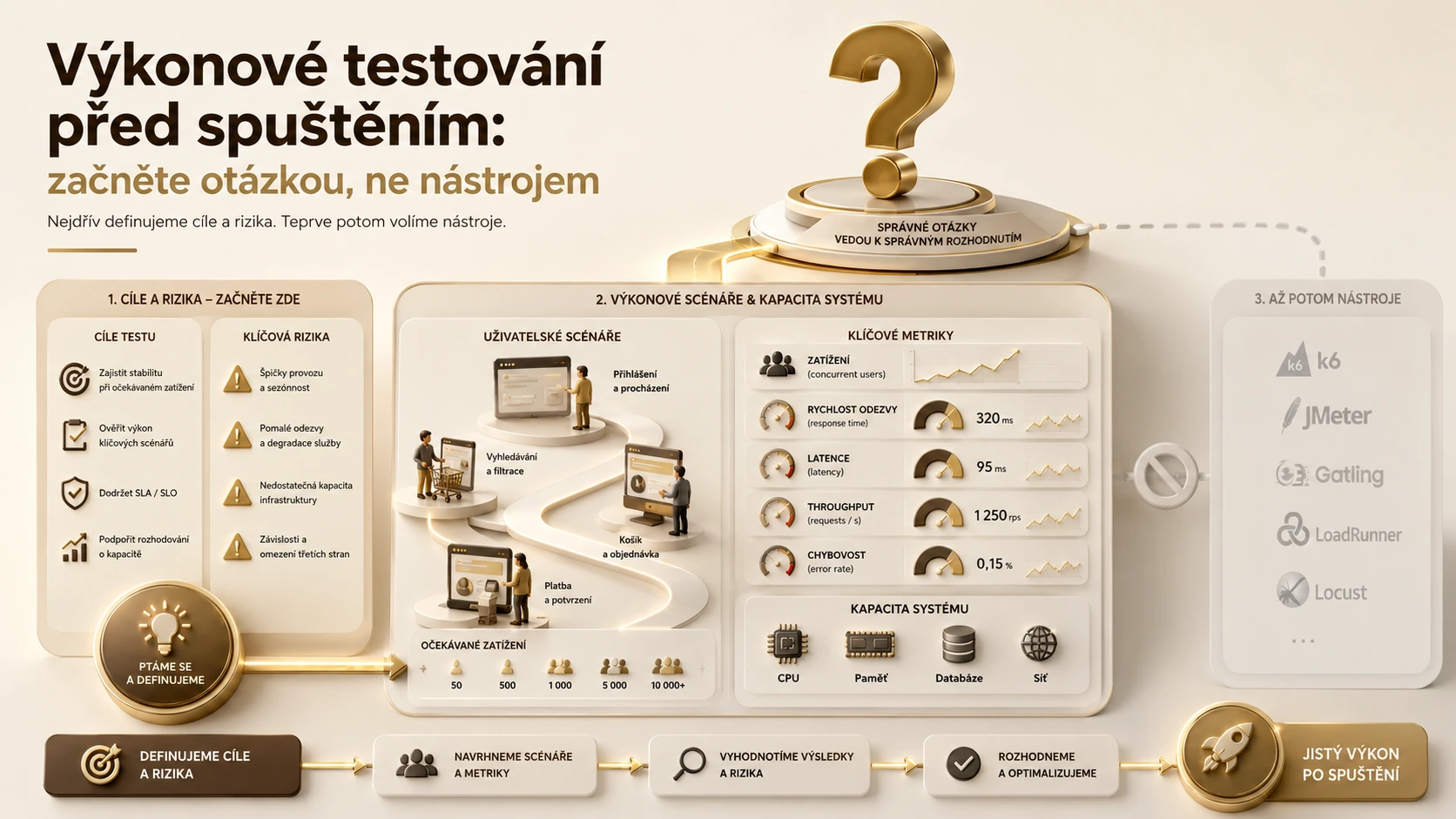
A load tool can generate impressive graphs without answering whether users will succeed. Effective performance testing begins with expected traffic, critical actions, service-level objectives and the failure modes the business cares about.
The environment, data volume and dependency behaviour must be realistic enough for conclusions to be useful.
How to do it well
Describe user workloads
Model arrival rates, concurrent users, task mix, think time and peak patterns.
Set measurable objectives
Define percentiles, throughput, error rate and recovery expectations for critical actions.
Prepare a representative environment
Align configuration, data volume and dependencies with production as far as practical.
Run tests progressively
Begin with baselines, then load, stress, spike and endurance scenarios where relevant.
Observe the whole system
Correlate user response with CPU, memory, database, queues and external services.
Retest after changes
Confirm improvements and preserve scripts and baselines for future regression.
What to avoid
- Testing only average response time.
- Generating unrealistic traffic with no user model.
- Running one large test immediately and learning little from the failure.
- Ignoring warm-up, caching and data growth.
- Optimising a component while end-to-end user time remains unchanged.
Practical example
For campaign launch, the key question may be whether 50,000 scheduled jobs are accepted within ten minutes while the UI remains usable.
A staged test can reveal that database writes are healthy but provider throttling creates a queue that exceeds the business deadline.
Lesson for practice
Performance testing is an investigation guided by business expectations. Clear workloads, percentiles, system evidence and repeatable baselines turn graphs into decisions.
A good practice does not have to be complicated. It should be intentional, repeatable and explainable: the team should understand why the control exists, what evidence it provides and how feedback will improve the next iteration.