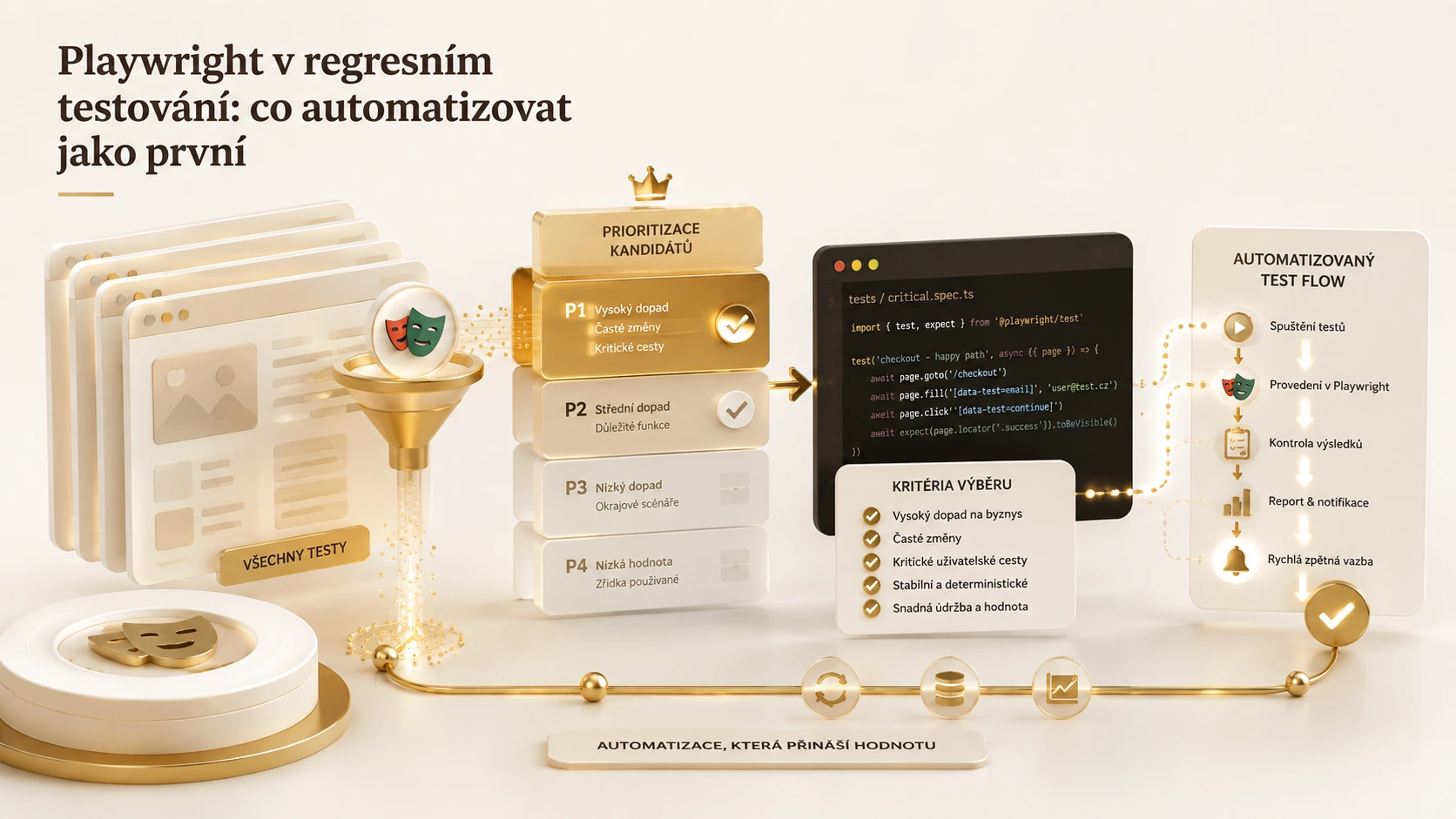
Why this matters
The first automated tests shape the future suite. If a team starts with fragile edge cases or visually complex screens, maintenance grows before trust is established. A better starting point is a small set of stable, business-critical journeys.
Playwright is powerful, but tool choice does not replace prioritisation. The aim is a fast and reliable signal that catches costly regressions early.
How to do it well
Map critical user journeys
Identify login, creation, payment, export or other flows whose failure would stop users or the business.
Estimate repetition and risk
Prioritise tests that are executed often and cover high-impact changes.
Stabilise test data
Create predictable accounts and data, with setup and cleanup independent of previous runs.
Use resilient locators
Prefer role, label and test identifiers over CSS structure or visible text that changes frequently.
Keep tests focused
Test one business outcome per scenario and move setup to APIs or fixtures where practical.
Measure reliability
Track duration, failure causes and flakiness; quarantine and repair unstable tests quickly.
What to avoid
- Automating every manual test without considering value.
- Building long end-to-end chains where one early failure hides all later checks.
- Depending on shared mutable data or execution order.
- Using arbitrary sleeps instead of waiting for observable conditions.
- Counting test quantity as success while the suite is slow or ignored.
Practical example
A marketing platform may start with login, audience creation, campaign scheduling and final status verification. Less stable visual customisation can remain exploratory until the core suite is trusted.
When a regression test fails, the report should include a trace, screenshot and relevant network evidence so the failure can be diagnosed without rerunning it locally.
Lesson for practice
A small dependable Playwright suite is more valuable than a large noisy one. Automate the highest-value stable journeys, design for diagnosis and expand only when the signal remains trustworthy.
A good practice does not have to be complicated. It should be intentional, repeatable and explainable: the team should understand why the control exists, what evidence it provides and how feedback will improve the next iteration.