Why this matters
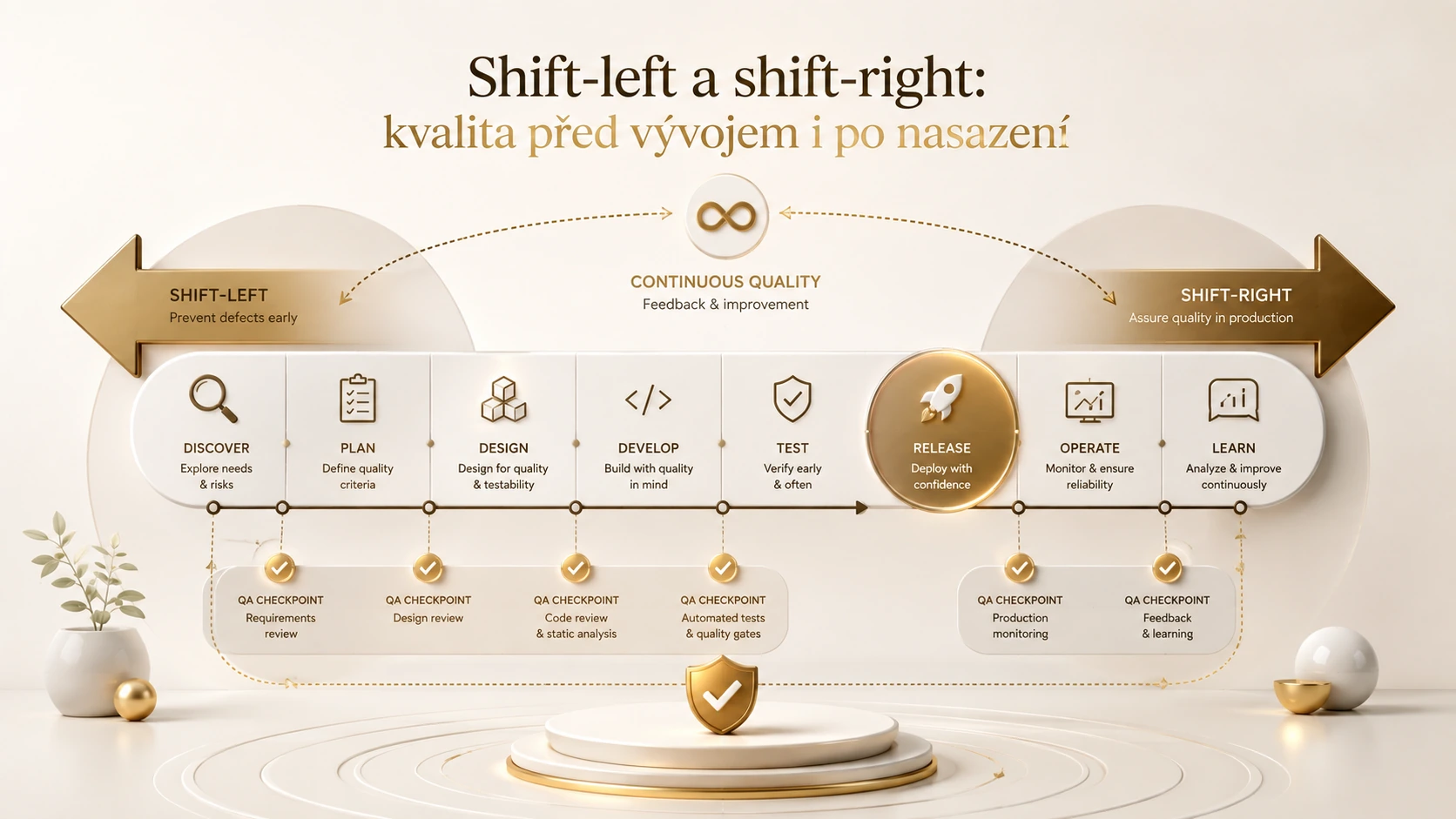
Shift-left practices prevent defects by asking quality questions earlier. Shift-right practices learn from real behaviour after deployment. Used together, they create a feedback loop rather than two competing slogans.
The objective is not to move all testing to one side, but to place each control where it provides the earliest and most reliable feedback.
How to do it well
Clarify quality risks during discovery
Discuss users, failure impact, data rules and observability before implementation starts.
Make requirements testable
Add examples, acceptance criteria and explicit error behaviour.
Automate fast checks in delivery
Run unit, contract, static and focused integration tests on every relevant change.
Release safely
Use feature flags, gradual rollout and rollback criteria for high-risk changes.
Observe real behaviour
Monitor technical signals, business outcomes and user friction after release.
Close the loop
Turn incidents, support cases and usage patterns into new requirements and regression scenarios.
What to avoid
- Calling QA into a finished feature only to confirm a predetermined release date.
- Treating monitoring as an operations-only responsibility.
- Collecting production data without defined questions or owners.
- Using shift-left to justify eliminating exploratory testing.
- Learning from incidents but failing to update tests and design guidance.
Practical example
A new import flow is reviewed early for file limits and error recovery. After release, monitoring shows users repeatedly failing on a specific encoding, which becomes a new validation and help requirement.
The cycle is complete only when that production insight changes the product and the regression suite.
Lesson for practice
Quality improves when feedback travels in both directions. Early collaboration reduces preventable defects; production observation reveals assumptions that no test environment can fully reproduce.
A good practice does not have to be complicated. It should be intentional, repeatable and explainable: the team should understand why the control exists, what evidence it provides and how feedback will improve the next iteration.