Why this matters
Retrospectives often identify familiar problems but fail to change daily behaviour. Too many actions, unclear ownership and no follow-up turn good discussion into recurring frustration.
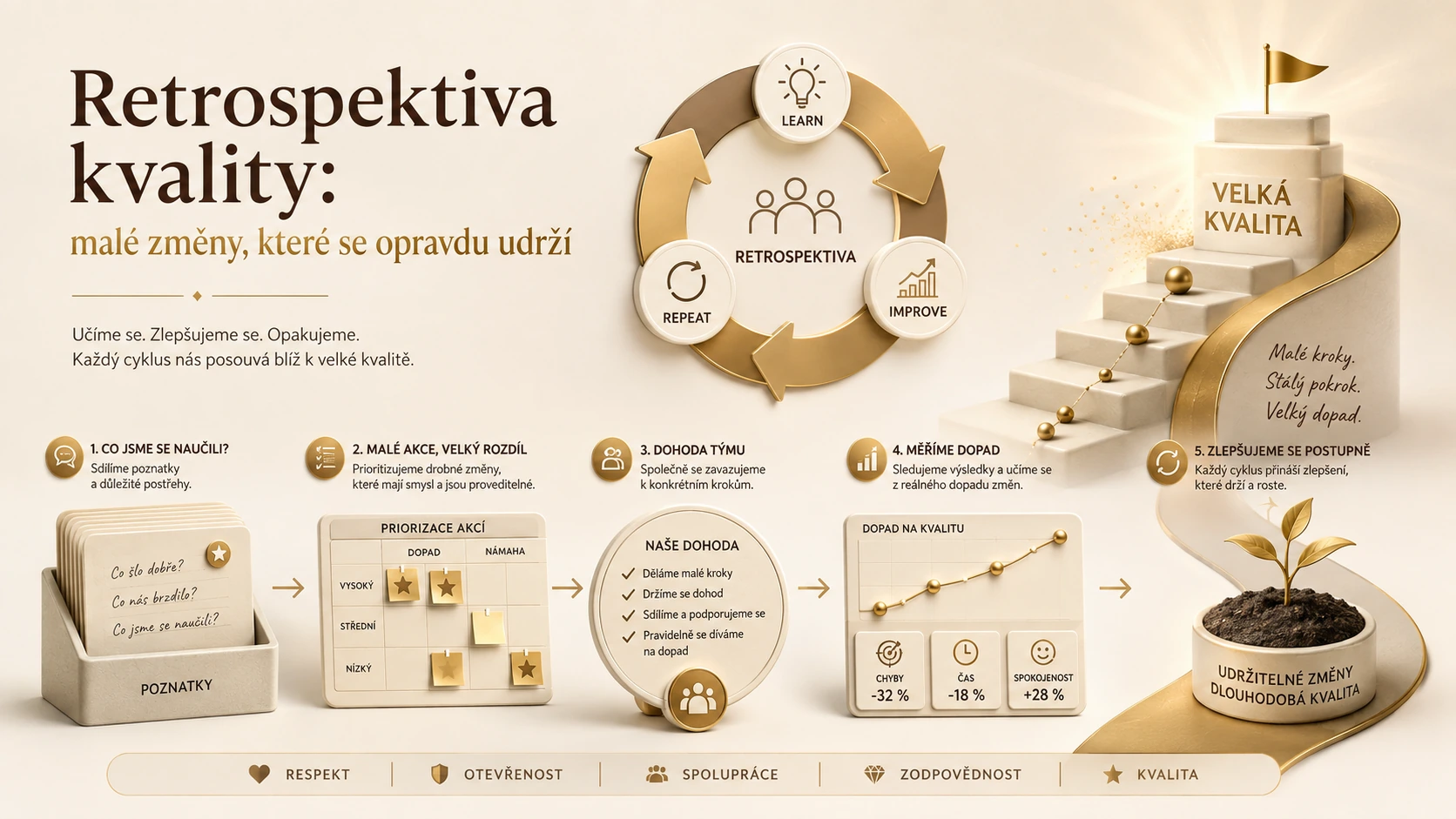
A quality-focused retrospective uses evidence, looks across the delivery system and treats improvement actions as experiments with measurable outcomes.
How to do it well
Bring evidence
Use incidents, escaped defects, flaky tests, delays and support themes rather than memory alone.
Map the pattern
Look for system conditions and hand-offs, not individual blame.
Choose one priority
Select the change with meaningful impact that the team can actually influence.
Define the experiment
State the action, owner, start date and the evidence that would show improvement.
Make it visible
Track the action in normal team work instead of a forgotten retrospective document.
Review and adapt
At the agreed date, keep, change or stop the experiment based on results.
What to avoid
- Creating ten actions for one sprint.
- Assigning actions to “the team” with no owner.
- Choosing solutions before agreeing on the problem.
- Measuring completion of the task instead of the effect.
- Starting every retrospective from zero without reviewing previous actions.
Practical example
Repeated late defect discovery leads to one experiment: QA joins refinement for the three highest-risk stories and records ambiguities found before development.
After a month, the team reviews rework and decides whether to expand, adjust or stop the practice.
Lesson for practice
Sustainable improvement is iterative. Evidence, one focused experiment, visible ownership and deliberate follow-up convert retrospective discussion into a real change in quality.
A good practice does not have to be complicated. It should be intentional, repeatable and explainable: the team should understand why the control exists, what evidence it provides and how feedback will improve the next iteration.