Why this matters
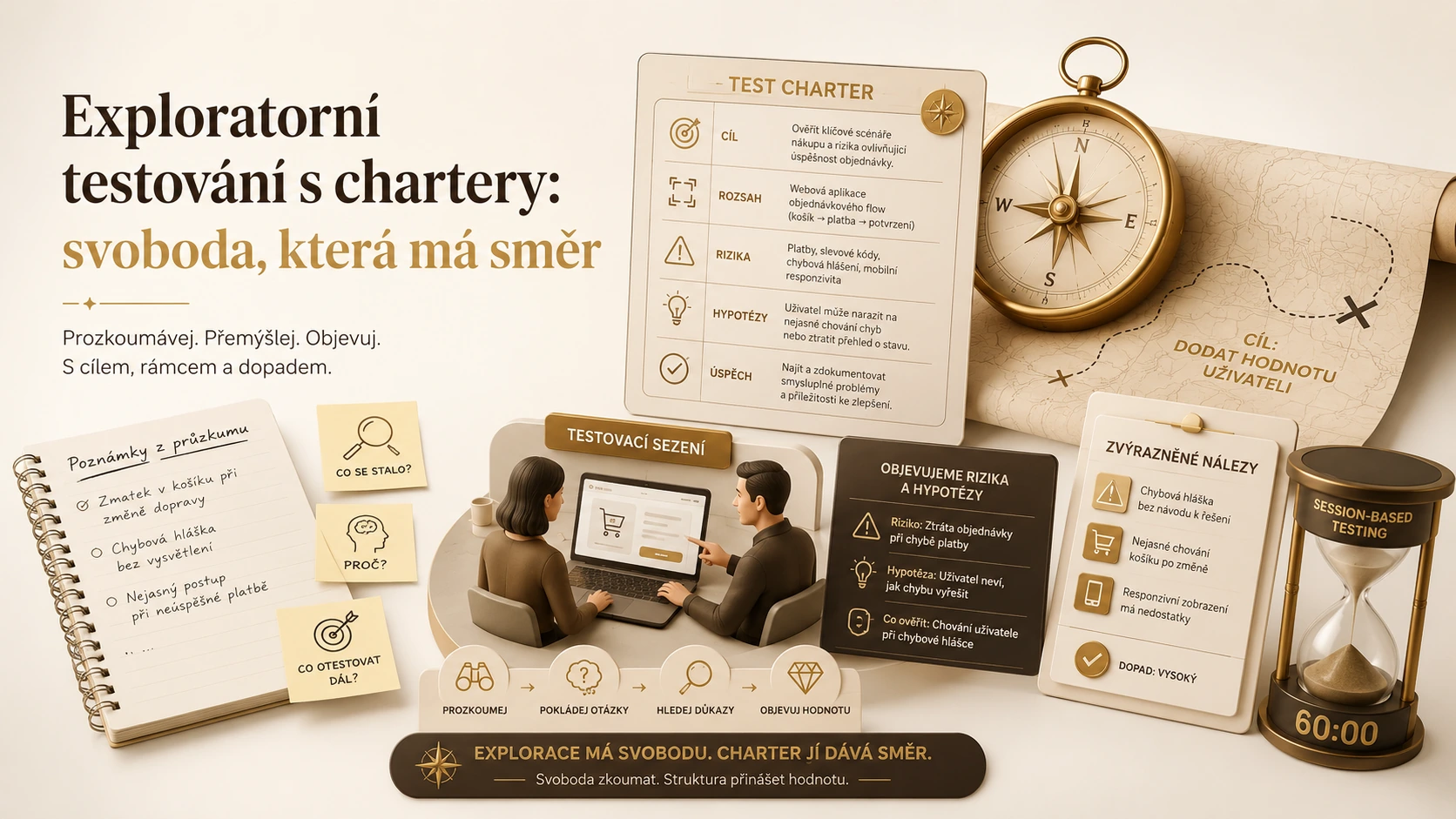
Scripted tests confirm known expectations; exploratory testing learns about risks that were not fully anticipated. The tester designs and executes tests at the same time, adapting to evidence.
A charter creates focus without turning exploration into a rigid script. Timeboxing and concise notes make the work visible and repeatable enough for collaboration.
How to do it well
Choose a risk area
Select a change, workflow, integration or user group where uncertainty remains.
Write the charter
Use the pattern: explore a target with resources to discover information about a risk.
Prepare data and tools
Set up personas, logs, browser tools and relevant reference information.
Timebox the session
Focus for 45–90 minutes and avoid expanding into unrelated areas.
Capture notes and evidence
Record coverage, observations, questions, defects and follow-up ideas.
Debrief and decide
Review findings with the team and convert important learning into actions or regression coverage.
What to avoid
- Starting without a mission and calling all interaction exploratory.
- Recording only defects while losing useful observations and unanswered questions.
- Trying to cover the entire product in one session.
- Interrupting the session with unrelated work.
- Failing to debrief, so learning remains with one tester.
Practical example
A charter may explore audience import using malformed files and interrupted networks to discover risks around partial processing and recovery.
The session may find no defect but reveal unclear status information, which becomes a UX improvement and a future test scenario.
Lesson for practice
Exploratory testing is structured learning under uncertainty. A focused charter, disciplined notes and a debrief turn tester curiosity into actionable product knowledge.
A good practice does not have to be complicated. It should be intentional, repeatable and explainable: the team should understand why the control exists, what evidence it provides and how feedback will improve the next iteration.